
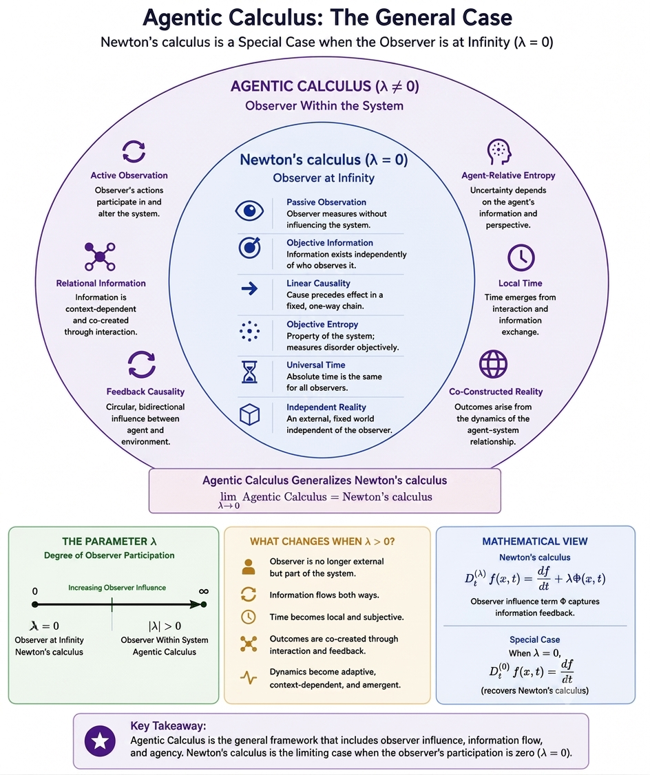
Newtonian mathematics assumes an observer outside the system it describes. Living systems don’t allow that assumption — and neither can a mathematics built to model them.
For over three centuries, science has described nature using a mathematical framework inherited from Newton. The central assumption of this framework is that the observer can be placed outside the system being studied.
In Newtonian mechanics, the observer is effectively at infinity. The observer measures but does not participate. Reality evolves according to fixed laws independent of who is watching.
This assumption works remarkably well for physics because planets, electrons, and falling objects do not possess agency. They do not interpret information, remember past events, or alter their future behaviour based on observation.
Living systems are fundamentally different.
A cell is not merely a physical object. It is an observer embedded within the system. It senses, remembers, interprets, decides, and acts. Every observation made by the cell changes the future state of the cell and its environment.
Biology therefore cannot be described adequately using a mathematics that assumes the observer is external.
The difficulty of mathematical biology is not primarily biological complexity. It is the use of the wrong mathematics.
If you know force F, mass m, and initial position x0, in principle you can compute trajectory as x(t). But this requires knowing velocity at some initial time.
Velocity (or equivalently, momentum p = mv) is an independent piece of information.
Position alone does not uniquely determine the future — two objects at the same place but with different velocities evolve differently. Therefore, to predict motion you need both position and momentum — this is the phase space idea. So, momentum is not just a convenience — it’s the minimum extra ingredient beyond position which makes the framework for mechanics complete.

T and P — free parameters to be calibrated. They are equivalent to Temperature and Pressure.dG/G — equivalent to change in volume.dV — system inefficiency. V is an Éclavyan volume.dμ/μ — equivalent to entropy change. This is the inverse of the Signal/Noise ratio.The above equation captures the flow of information missing from current mathematics framework where we are only working with one aspect — entropy. The contrast between the classical Thermodynamic heat engine and Reuben’s Chronodynamic engine is shown below.
Understanding the Conjugate
An éclaves category is a category \(\mathcal{C}\) with products and an associated generative primitive, an object \(\mathbb{A}\) of \(\mathcal{C}\) whose objects are necessarily of the kind
for some finite index set I with some requirements which rather than axiomatising and adding to the burdock thicket of generalities we ask the reader to imagine to arise from imagining the category to be a subcategory of the category of sets and regarding the above monic morphisms as set-theoretic inclusions. We denote this agreement by rewriting in all that follows the above monic morphism by
and say that V is a \(\mathcal{C}\)-subobject of \(\mathbb{A}^{I}\).
Examples of \(\mathbb{A}\) are: