
At the system level, as a result of his work on the imprecision/noise duality, Reuben discovered the Fourier-Boltzmann Hamiltonian. Together with his chronodynamic logical model, it powers a spike-driven analogue VLSI systems architecture that combines signal-extraction with computation.
This work, which is proprietary, is the culmination of two decades of Reuben’s research, beginning with his 2001 paper in the Proceedings of the Royal Society London on spike-driven analogue VLSI architecture for digital computation.
The Fourier-Boltzmann Hamiltonian, in a special case, recovers an identity studied by Michio Sugeno in his 1974 Tokyo PhD thesis on subadditive measures. More significantly, it also proves that quantum mechanics is not required for entanglement — entanglement instead arises in the chronodynamics that Reuben discovered. Chronodynamics arises from the internal degrees of freedom of time itself.
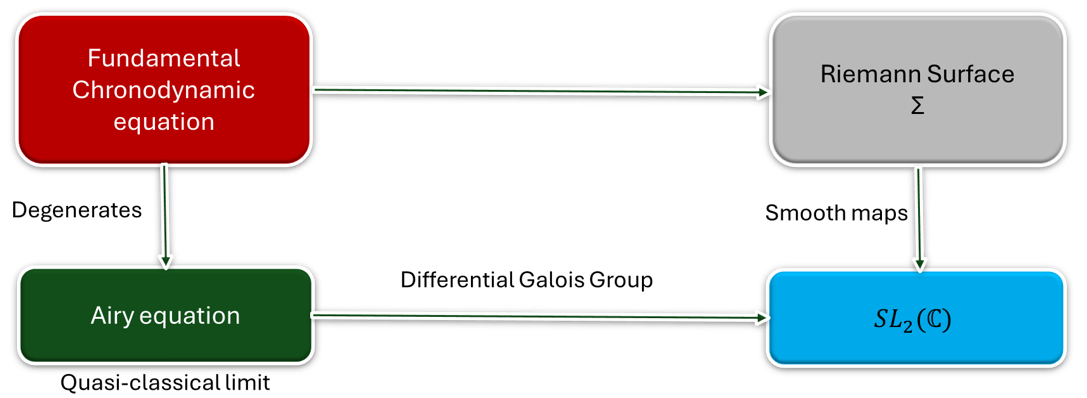
Schymean logic and the hydrodynamics of carrier-transport in semiconductor devices.
The dynamics of time and memory.
[A] embodies an analogue hardware architecture capable of dynamically trading off resolution-loss against noise-gain to extract plasticity. It incorporates analogue-to-digital (A/D) conversion via monodromy — a radical departure from the usual A/D-conversion process. A/D-conversion via monodromy is inherently robust, whereas the commercial A/D converters in universal use today (e.g. Analog Devices, Inc.) are not, since they rely on the magnitude of the signal.
[B] embodies the energy-information duality as formulated by Reuben, incorporating:
The Chronodynamics of Information-Flow involves the dynamics of changes in the degree of synchrony between spiking units (for instance, neurons) — ranging from units spiking in perfect synchrony, to highly asynchronous spiking, to anywhere between the two extremes.
This was made possible by Reuben’s discovery of the Fourier-Boltzmann Hamiltonian, which represents a way of thinking about the flow of information, rather than information itself — something Shannon entropy fails to do.
Spikes are tokenised to represent logical propositions.
Includes the chiral hydrodynamics of time and the thermodynamics of spiking analogue VLSI systems.
A formalism enabling the decomposition of dynamics into an integrable part and a structurally unstable one, along with a quantisation of time resulting in the specific morphology of spikes used in the SEMA architecture.
Steering Entanglement in Massively Parallel Analogue VLSI.
A radical departure from the spin glasses studied by physicists.